

Mitzvah Campaigns
In the late 1960s and throughout the 1970s the Lubavitcher Rebbe instituted a series of ten Mitzvah campaigns designed to increase awareness of the importance of Mitzvot for Jews of all backgrounds. The Ten-Point Campaign focused on Mitzvot which, because of their centrality to the Torah's guide to life, are ideally suited for a first experience of the mitzvah.
For more on the Ten-Point Mitzvah Campaign please click here.
|
Women and girls over 3 years of age are encouraged to welcome the Shabbat each week by lighting Shabbat candles. Click here for more information. |
|
|
At one's Bar Mitzvah the obligation to keep the Mitzvot begins in ernest, At that time Tefillin should be worn each morning except on Shabbos and Holidays. Symbolically, Tefillin represent the subjegation of the mind and heart to the will of the Almighty. |
|
|
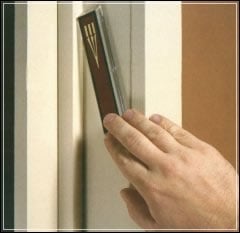
The Mezuzah is a small parchment scroll on which a scribe has hand-written the "Shema Yisrael" prayer. The scroll is then rolled up, placed in a protective case, and affixed to the doorposts of a Jewish home or office. The Mezuza symbolizes G‑d's constant protection of our homes and those who live within. |
|
|
The study of our Holy Torah is central to our Jewish identity. One of the meanings of the word Torah is guidance. A steady commitment to Torah study is the key to ensuring a Torah-guided life. |
|
|
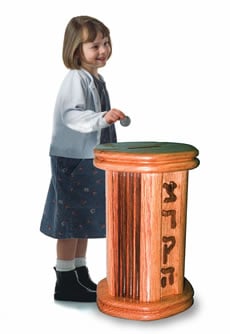
Tzedakah means righteuosness. The Torah tells us that giving charity is the key to wealth. When make make proper use of the gifts that G‑d has given us by being charitable with them, G‑d responds in kind by bestowing upon us an abundance of all our needs. |
|
|
Our surroundings at home have a tremendous impact upon our lives. By filling a Jewish home with holy books we create an environment that radiates G‑dliness and spirituality. |
|
|
We've all heard the saying "You are what we eat". When we eat only things that G‑d has deemed are appropriate for us, we refine our body such that the physical body becomes a vehicle through which one can impact the spiritual as well. |
|
|
Rabbi Akive said, "This is the central principle of the Torah". True love of ones fellow is looking past their faults in the same manner that we look past our own faults. |
|
|
When G‑d gave Moshe the Torah he did so only after the children were offered as guarantors of the Torah. A Torah education is the one foolproof way to ensure the continuity of Judaism for future generations. |
|
|
|




 Kosher
 Love of One's Fellow Jew

 Family Purity